
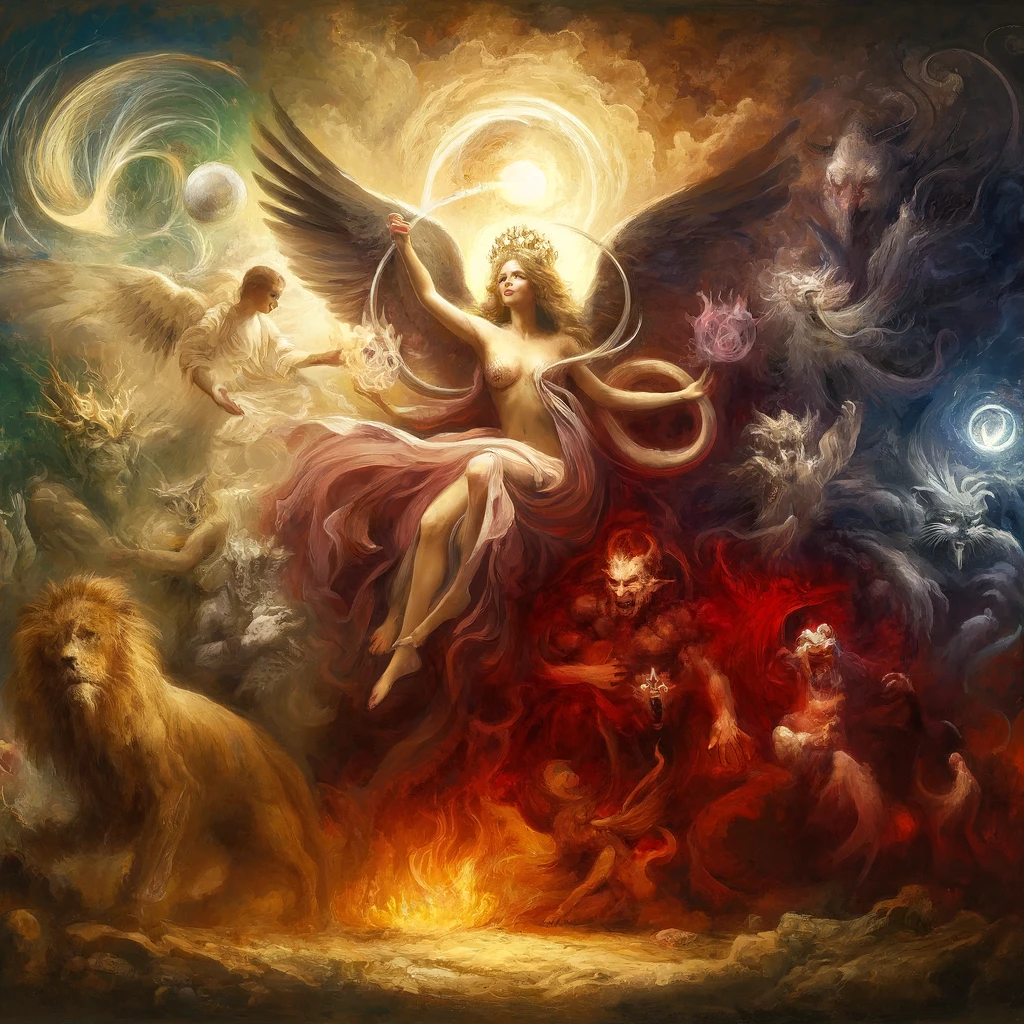
When it comes to descriptions of Satan’s appearance in the Bible, the Scriptures offer more symbolic and metaphorical descriptions than direct, physical ones. The Bible uses imagery and symbolism to represent Satan’s nature and actions rather than to provide a detailed physical description. Here are key verses that, while not offering a direct portrait, give insight into the character and symbolic representation of Satan:
- Ezekiel 28:12-17 (NIV) This passage is often interpreted as referring to Satan, describing him as a model of perfection, full of wisdom and perfect in beauty. It mentions how he was in Eden, the garden of God, and was adorned with every precious stone, but was cast down because of his pride.
- Isaiah 14:12-15 (NIV) Often thought to describe Satan’s fall from heaven, this passage refers to a figure who sought to ascend above the stars of God and make himself like the Most High, only to be brought down to the realm of the dead.
- Revelation 12:3-4, 9 (NIV) Here, Satan is depicted as a great red dragon with seven heads and ten horns, and seven crowns on his heads. His tail swept a third of the stars out of the sky and flung them to the earth. The dragon is identified as the devil, or Satan, who leads the whole world astray.
- 2 Corinthians 11:14 (NIV) “And no wonder, for Satan himself masquerades as an angel of light.” This verse suggests that Satan can appear in a deceiving form, not necessarily as a figure of darkness but as one of beauty and light to deceive.
- 1 Peter 5:8 (NIV) “Be alert and of sober mind. Your enemy the devil prowls around like a roaring lion looking for someone to devour.” This metaphorical image portrays Satan not in a physical form but in terms of behavior and intent, highlighting his predatory nature.
These verses collectively suggest that Satan’s appearance in the Bible is not meant to convey a literal physical form but rather to symbolize his qualities, actions, and the deceptive nature of his presence. The imagery ranges from a figure of beauty that fell from grace to a deceiving angel of light, and even a monstrous red dragon, all serving to underline the multifaceted and insidious nature of Satan as described in biblical texts.
Related Reading
- How the devil seeks to separate us from Jesus
- How did Jesus defeat Satan
- Resisting the devil with biblical wisdom
- The four powerful angels over Satan
Understanding Satan’s Nature: What the Bible Actually Says
Popular culture has shaped many distorted images of Satan — a red figure with horns, or a cartoon villain. But Scripture paints a far more sobering and instructive picture. Understanding what the Bible actually reveals about Satan’s nature helps us recognize his tactics and stand firm against them.
Additional Scriptures on Satan’s Nature
- 2 Corinthians 11:14 (KJV) — “And no marvel; for Satan himself is transformed into an angel of light.” This is perhaps the most important verse for practical spiritual discernment. Satan does not always appear evil. He often appears enlightened, reasonable, and appealing. Deception is his chief weapon.
- John 8:44 (KJV) — “He was a murderer from the beginning, and abode not in the truth, because there is no truth in him. When he speaketh a lie, he speaketh of his own: for he is a liar, and the father of it.” Every lie traces its roots back to the enemy of souls. The truth is your greatest defense.
- Revelation 12:9 (KJV) — “And the great dragon was cast out, that old serpent, called the Devil, and Satan, which deceiveth the whole world: he was cast out into the earth, and his angels were cast out with him.” Satan’s primary occupation is deception — on a world scale. The antidote is the Word of God.
- Job 1:6-7 (KJV) — Satan appears before God, roaming “to and fro in the earth.” He is active, intentional, and strategic — but he operates within the limits God allows. He is not omnipresent or all-powerful.
Key Distinctions: What Satan Is Not
Understanding Satan’s limitations is as important as recognizing his activity:
- He is not omnipresent. Only God is everywhere. Satan works through a network of spirits, but he himself cannot be everywhere at once.
- He is not omniscient. He does not know your thoughts unless you speak or act on them. Guard your mind with the Word (Romans 12:2).
- He is not omnipotent. He is a defeated foe. Colossians 2:15 says Jesus “spoiled principalities and powers” and “made a shew of them openly, triumphing over them.”
- He is not eternal. Revelation 20:10 describes his final, irreversible end. His time is limited, and he knows it (Revelation 12:12).
Walking in Awareness Without Fear
The believer’s posture toward Satan should be neither obsession nor ignorance — it should be sober awareness paired with bold confidence in Christ. James 4:7 is the prescription: “Submit yourselves therefore to God. Resist the devil, and he will flee from you.” The power to resist comes from submission to God, not from focus on the enemy.
A Prayer of Authority in Christ
Father, I thank You that greater is He that is in me than he that is in the world. I do not fear the enemy, but I take him seriously. Give me discernment to recognize deception, courage to stand in truth, and humility to stay submitted to You. All authority belongs to Jesus — and I stand in that authority today. In His name, Amen.