
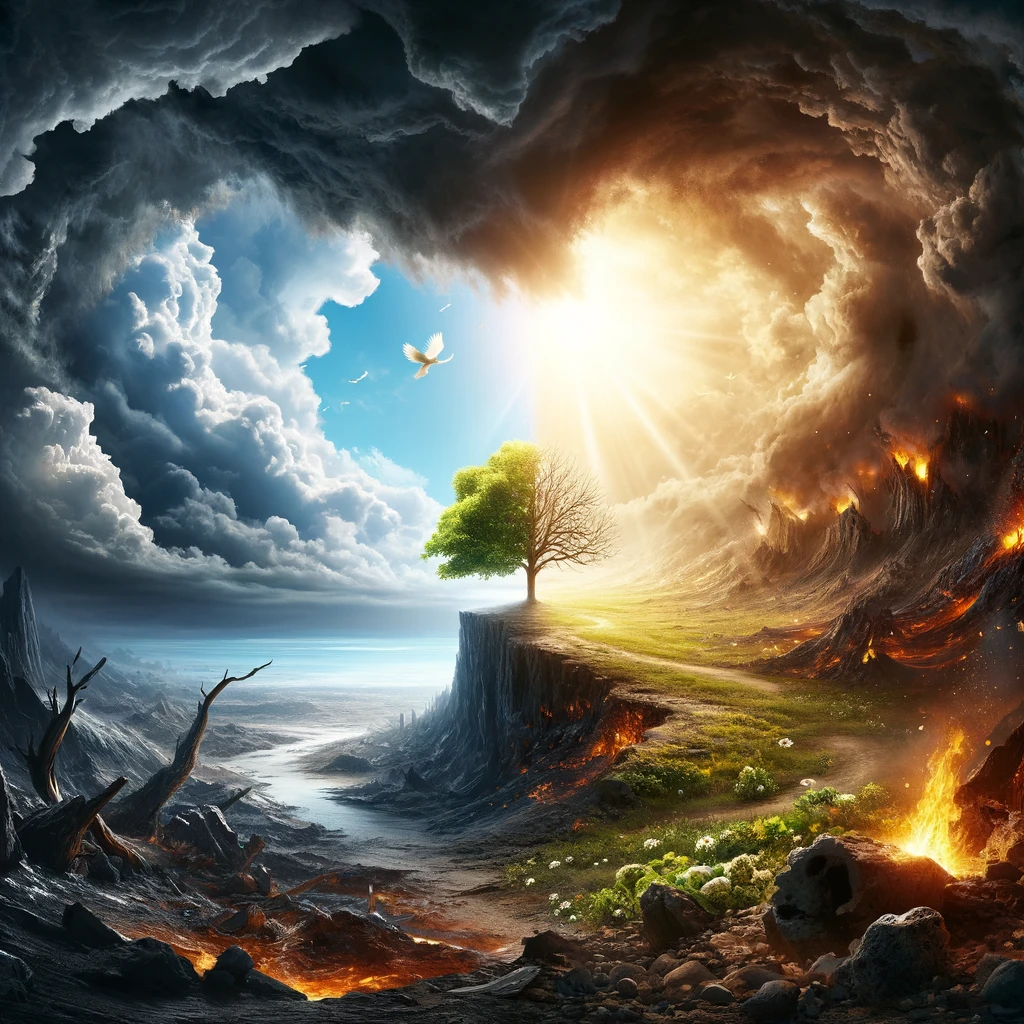
The concept of the Earth’s destruction is touched upon in various parts of the Bible, often in the context of apocalyptic prophecies, end times, or God’s judgment. These references serve as warnings, lessons, or insights into the power and plans of God regarding creation and its eventual renewal or end. Here are five Bible verses that relate to the theme of the Earth’s destruction or the profound changes the Earth will undergo according to biblical prophecy:
- 2 Peter 3:10 – “But the day of the Lord will come like a thief, in which the heavens will pass away with a roar and the elements will be destroyed with intense heat, and the earth and its works will be burned up.”
- This verse speaks to the sudden and transformative nature of the Day of the Lord, emphasizing the complete overhaul of the current creation in preparation for the new.
- Revelation 21:1 – “Then I saw a new heaven and a new earth; for the first heaven and the first earth had passed away, and there is no longer any sea.”
- Here, John’s vision in Revelation points to the ultimate renewal of all creation, which involves the passing away of the old earth and the establishment of a new, perfected creation.
- Isaiah 24:19-20 – “The earth is broken asunder, The earth is split through, The earth is shaken violently. The earth reels to and fro like a drunkard And it totters like a shack, For its transgression is heavy upon it, And it will fall, never to rise again.”
- Isaiah’s prophecy details a time of great turmoil and destruction for the earth, symbolizing the consequences of collective sin and rebellion against God.
- Matthew 24:35 – “Heaven and earth will pass away, but My words will not pass away.”
- Jesus emphasizes the transient nature of the current creation compared to the eternal and unchanging nature of His words and teachings.
- Joel 2:30-31 – “I will display wonders in the sky and on the earth, Blood, fire and columns of smoke. The sun will be turned into darkness And the moon into blood Before the great and awesome day of the Lord comes.”
- This verse portrays dramatic cosmic and earthly signs that will precede the Day of the Lord, symbolizing the profound changes that will occur before the final act of God’s plan.
These verses collectively remind us of the impermanence of the current world and the importance of focusing on eternal truths and God’s promises. The envisioned destruction or transformation of the Earth serves as a backdrop for the ultimate hope and renewal that is central to Christian eschatology—the new heaven and new earth, where righteousness dwells.
Hope Beyond the Horizon: The New Creation
The biblical narrative about the end of this world is not ultimately a story of loss — it is a story of renewal. Yes, Scripture speaks clearly about judgment, purification, and the end of the present age. But it ends not with destruction, but with creation. God does not simply destroy the old — He makes all things new.
More Scriptures on the End Times and New Creation
- Revelation 21:1-2 (KJV) — “And I saw a new heaven and a new earth: for the first heaven and the first earth were passed away; and there was no more sea. And I John saw the holy city, new Jerusalem, coming down from God out of heaven, prepared as a bride adorned for her husband.” The end of this age is the beginning of the next — the new creation, the eternal city, the wedding of God and His people.
- Romans 8:20-22 (KJV) — “For the creature was made subject to vanity, not willingly… For we know that the whole creation groaneth and travaileth in pain together until now.” Creation itself is waiting for redemption. The world is not heading toward meaninglessness — it is heading toward renewal.
- Matthew 24:35 (KJV) — “Heaven and earth shall pass away, but my words shall not pass away.” Even as creation ends, God’s Word remains. His promises outlast all things.
- Isaiah 65:17 (KJV) — “For, behold, I create new heavens and a new earth: and the former shall not be remembered, nor come into mind.” God is the initiator of the new creation. This is not humanity’s achievement — it is God’s sovereign act of renewal.
What the End of the World Means for How We Live Now
A correct understanding of the end should not produce fear or passivity — it should produce hope and urgency:
- Hold earthly things loosely. If this world is temporary, our attachment to its treasures should be proportionate. Build for eternity, not just for comfort.
- Live with urgency about eternity. The end is certain; only the timing is unknown. This should motivate us to share the gospel, reconcile relationships, and live wholeheartedly for God.
- Find comfort in God’s sovereignty. The world is not spinning out of control. God is the Alpha and the Omega — the beginning and the end. He writes the last chapter.
A Prayer for Eternal Perspective
Lord, help me to hold this present world in proper perspective — to love it as Your creation without clinging to it as my home. Thank You that the final word is not destruction but renewal. I look forward to the new heaven and new earth You have promised, where there will be no more sorrow, no more death, no more separation from You. Come, Lord Jesus. In Your name I pray, Amen.